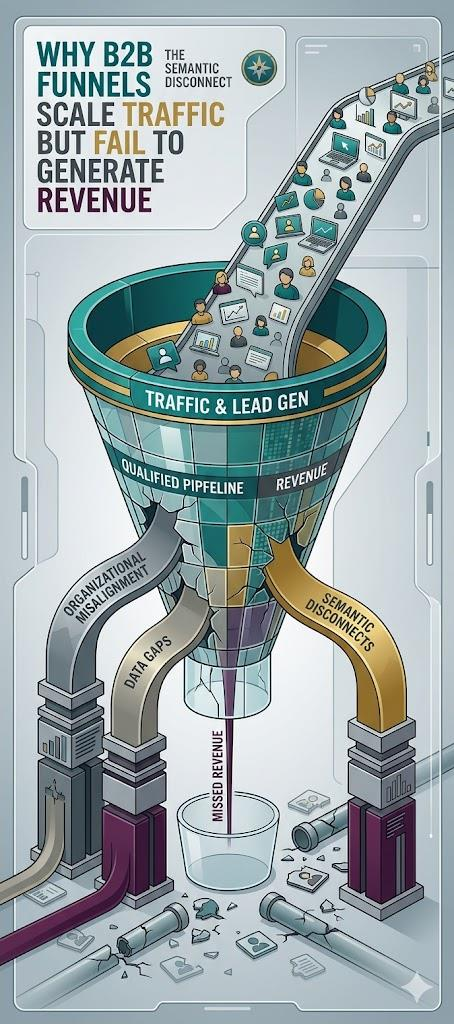
Why B2B Funnels Scale Traffic but Fail to Generate Revenue
The reason most B2B websites “succeed” at traffic but fail at pipeline has nothing to do with the UI. It has to do with Signal Coherence, and most organizations are measuring the wrong layer.
Maria Wright-Noor
Founder & Managing Principal · Snowflake · Microsoft Fabric · Databricks · dbt
The reason most B2B websites “succeed” at generating traffic but fail at generating pipeline has nothing to do with the UI. It has to do with Signal Coherence, and most organizations are measuring the wrong layer.
The Four Levels of Funnel Interoperability
Optimizing a B2B funnel requires four levels of alignment. Most businesses solve the first two, tracking clicks and forms, but ignore the latter two, which is where high-quality leads actually reside. Semantic Funnel Alignment is where lead quality lives or dies.
The Semantic Layer: Where Lead Quality Lives or Dies
If “Qualified Lead” is defined differently by your marketing automation, your CRM, and your Sales VP, your funnel isn’t driving growth, it’s driving internal friction. Your website ends up learning inconsistency instead of conversion.
A critical distinction: a form fill alone does not resolve intent. It captures an identity, but it doesn’t guarantee a “ready to buy” signal. That requires layering Firmographics, Technographics, and Intent Signals on top of the lead data. A lead that downloads a PDF but isn’t terminology-bound is just noise.
If “Qualified Lead” is defined three different ways across Marketing, CRM, and Sales, you don’t have a funnel, you have an argument with a dashboard attached.
Lead Integrity as a Structural Issue
Beyond intent, Entity Resolution becomes a funnel-integrity issue. If your platform cannot consistently answer “is this lead part of an active Buying Committee at a Target Account,” your sales team is chasing fragmented individuals.
Fragmented Records. Disconnected data creates an incomplete context.
The Result. Your “best” leads get ignored because they look like low-intent outliers in your CRM.
Five Structural Decisions That Make Lead Gen Tractable
The organizations that generate the best leads don’t just “buy more traffic.” They build a data foundation that makes lead quality defensible.
Unified ICP Definition (The Canonical Contract)
Establish a shared definition of your Ideal Customer Profile that both Marketing and Sales sign off on. An AI-ready ICP includes tech-stack triggers and explicit misses in pipeline targets.
Medallion Architecture for Lead Data
Bronze: Raw website hits and form fills. Silver: Terminology-bound and enriched records (e.g., via ZoomInfo or Clearbit). Gold: High-intent, account-resolved leads. Rule: no sales rep should ever see a “Bronze” lead.
Account-Based Enforced Join Layer
Every lead must be mapped to an Account ID. Without this, you are running a B2C funnel for people who happen to have corporate emails.
Semantic Lead Scoring
Scoring shouldn’t just be for “clicks.” It should be for verifiable signals like repeated topic-specific consumption or competitor comparison page visits.
Closed-Loop Feedback Infrastructure
Automate the flow of “Lead Rejected” reasons from Sales back into the Marketing data layer to “train” your funnel to stop attracting the wrong people.
The Fix: A Modern, Semantic Approach
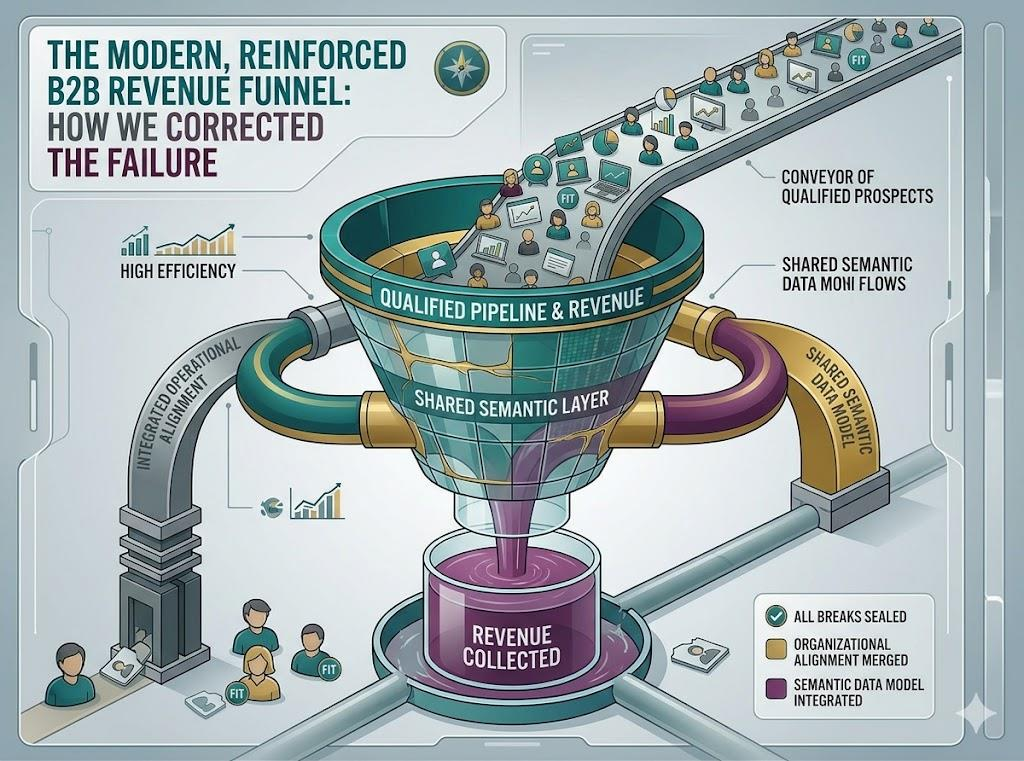
The modern revenue funnel is no longer a leaking sieve; it’s a reinforced, closed-loop system designed for clarity and value. By repairing the gaps identified in the failed model, we guide Qualified Pipeline and Revenue straight into the collection cup.
The reinforced funnel: organizational misalignment and data gaps merged into the main pipeline. A Shared Semantic Data Model serves as the internal filtration layer.
We address critical failure points by integrating previously diverging flows. Organizational Misalignment and Data Gaps are structurally merged with the main funnel body, creating unified resource flows. A Shared Semantic Data Model serves as a reliable internal filtration layer, aligning metrics and ensuring consistent language across every department.
In the leaking model these were separate, fractured leaks. Here, they become internal, value-creating functions. The resulting funnel is a cohesive revenue engine, delivering a high, positive, and measurable outcome.
You don’t fix a leaking funnel by buying more traffic. You fix it by giving every department the same definition of a qualified lead.
If your reports look healthy on the surface but Sales is still complaining about lead quality, the issue almost certainly lives in the semantic layer. We help diagnose it before anyone touches the ad budget.
If your dashboards are healthy but your revenue isn’t, the problem is structural. Let’s diagnose the semantic layer before anyone touches the ad budget.